Turmeric and Black Pepper: The Bioavailability Duo That Changes Everything
# Turmeric and Black Pepper: The Bioavailability Duo That Changes Everything
Turmeric has been used for thousands of years in Ayurvedic and traditional Chinese medicine as a remedy for inflammation, digestive complaints, and general vitality — but there's a catch. On its own, the body struggles to absorb curcumin, turmeric's most celebrated active compound. Pair it with black pepper, however, and the story changes dramatically.
The Combination Explained
This classic herbal pairing brings together two spices that have shared kitchen and medicine cabinet space across cultures for centuries. Understanding why they work so well together requires a brief look at each ingredient:
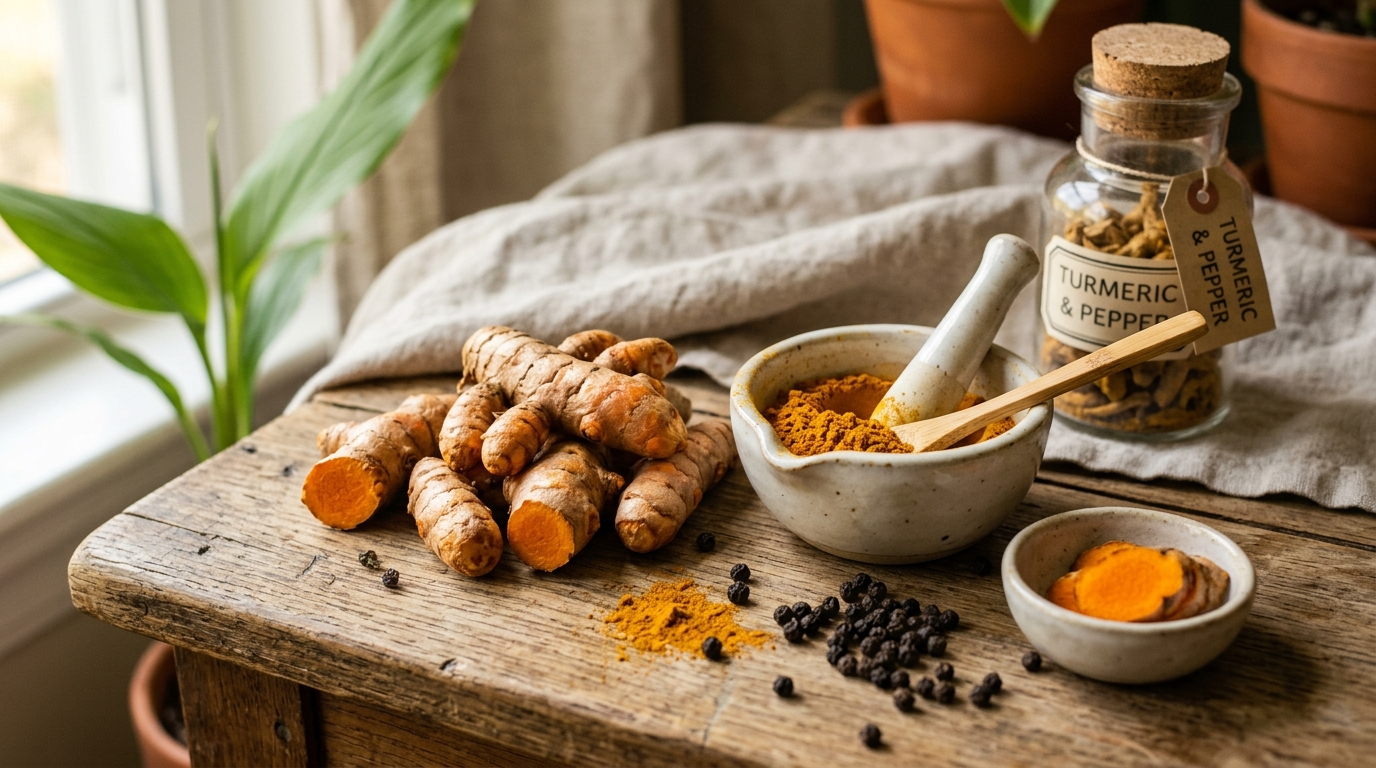
**Turmeric (*Curcuma longa*)** is a rhizome (underground stem) native to South and Southeast Asia. Its deep golden colour comes from a group of polyphenols called curcuminoids, of which curcumin is the most studied. Curcumin is responsible for most of turmeric's anti-inflammatory and antioxidant properties. The challenge is that curcumin is poorly soluble in water, rapidly metabolised by the liver and intestinal wall, and quickly eliminated from the body — meaning very little of it actually reaches the bloodstream when consumed alone.
**Black Pepper (*Piper nigrum*)** contains an alkaloid called piperine, which gives pepper its characteristic heat. Piperine is not just a flavour compound — it is a potent bioavailability enhancer. It works by inhibiting the liver and intestinal enzymes (particularly UDP-glucuronosyltransferase) that would otherwise break curcumin down before it can be absorbed. Piperine also increases the permeability of intestinal cell membranes, allowing more curcumin to pass through the gut lining into the bloodstream, and slows the removal of curcumin from cells by inhibiting efflux pumps.
The result of combining the two? A synergy that is far greater than the sum of its parts.
What It's Used For
This combination is most commonly used to support:
Who might consider this combination? People dealing with ongoing joint stiffness or inflammatory conditions, those looking for natural antioxidant support, or anyone wanting to get more out of their turmeric intake. It is also popular among people following anti-inflammatory dietary approaches.
From a dosage perspective, credible sources and clinical studies typically use 500–2,000 mg of curcumin extract per day, paired with approximately 5–20 mg of piperine (a ratio of roughly 100:1). Taking the combination with a meal containing healthy fats — such as olive oil or avocado — can further improve absorption, as curcumin is fat-soluble.
Research Roundup
The foundational study on this combination was published by Shoba et al. in *Planta Medica* (1998), a landmark human clinical trial showing that adding just 20 mg of piperine to 2 grams of curcumin increased curcumin's bioavailability by up to **2,000%** in human volunteers. This remains one of the most cited findings in herbal supplement research.
More recent work has built on this foundation. A 2026 systematic review published in *Frontiers in Nutrition* examined randomised controlled trials from 2023 to 2026 and found that curcumin-piperine supplementation consistently reduced inflammatory biomarkers — including C-reactive protein (CRP), interleukin-6 (IL-6), and high-sensitivity CRP — across populations with metabolic syndrome, type 2 diabetes, and cardiovascular conditions. The combination was also associated with improvements in antioxidant capacity and reductions in oxidative stress markers.
A 2025 randomised, double-blind, placebo-controlled trial published in the *European Journal of Nutrition* found that 1,000 mg/day of curcumin combined with 10 mg/day of piperine for 12 weeks improved body composition and inflammatory markers in patients with mild-to-moderate inflammatory bowel disease.
It is worth noting that some *in vitro* (laboratory cell model) research suggests that piperine may not fully overcome all of curcumin's intestinal permeability challenges — meaning the picture is still evolving. Most of the strong clinical evidence comes from studies using standardised curcumin extracts rather than whole turmeric powder, so results from food-based consumption may differ. Research in this area is ongoing and promising, but not all findings have been replicated in large-scale trials.
Available On Our Site
If you're looking to incorporate this combination into your routine, you can find **Turmeric & Black Pepper Capsules & Tincture** in our shop — a convenient way to get both ingredients together in a standardised form. For those who prefer a broader spice-based approach, our **4 In 1 Spice — Cinnamon, Turmeric, Cayenne and Ginger Capsules** offers turmeric alongside other warming, anti-inflammatory botanicals. We also carry **Turmeric** and **Black Pepper Capsules** individually, as well as a **Turmeric Health Blend** for those wanting full support from this golden root.
Safety & Disclaimer
*This article is for informational purposes only and does not constitute medical advice. Always consult a qualified healthcare provider before starting any new supplement, especially if you have an existing health condition or are taking prescription medication.*
**Known interactions and contraindications to be aware of:**
As with all herbal supplements, quality and standardisation matter. Look for products that specify curcumin content and piperine percentage to ensure you're getting a therapeutically relevant dose.